
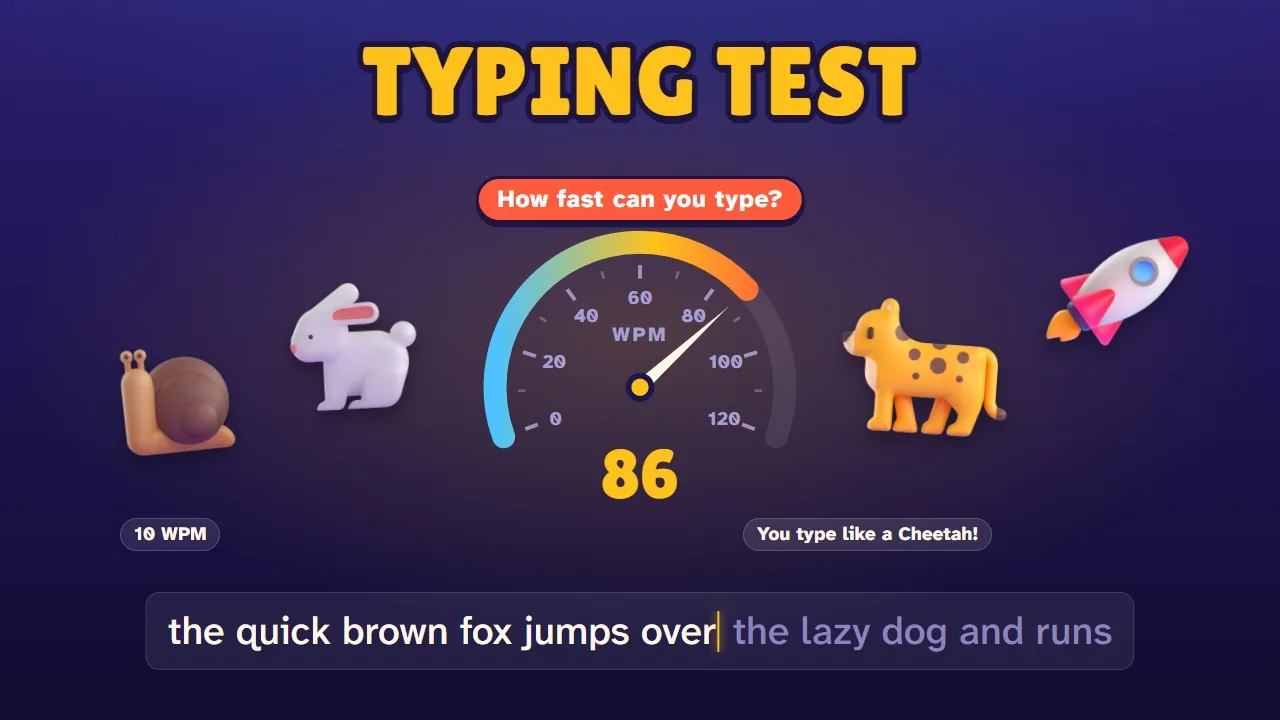
About this typing test
This free typing test checks how fast and how accurately you type. There's nothing to press first: the test is ready when the page opens, so just start typing the words in the box. The clock starts with your first key. When the time is up you get your typing speed in words per minute (WPM), your accuracy and a fun speed rank, from Snail all the way to Rocket.
Pick a quick 15 or 30-second sprint, the classic 1-minute typing test, or a longer 2, 3 or 5-minute test. You can also type a set number of words: 10, 25, 50 or 100. Then choose what to type: common words, whole sentences, short stories from Aesop's fables, passages from classic books, or easy words in the kids mode. Add punctuation, numbers or capital letters when you want a harder test.
Your results show net and gross WPM, characters per minute, accuracy and consistency, a speed chart for every second, your slowest keys and a keyboard heatmap of your mistakes. Your personal bests and progress are saved in your browser, the daily test gives everyone the same text each day, and you can download a free typing certificate with your name on it.
The test works on computers, Chromebooks, tablets and phones. On a phone, tap the text and type with your on-screen keyboard. No sign-up, no download, nothing to install.
1-minute, 3-minute and 5-minute typing tests
The 1-minute typing test is the most popular: long enough for a fair score, short enough to try again and again. The 15 and 30-second tests measure your top speed. The 2, 3 and 5-minute tests show whether you can keep that speed up, which is closer to real typing work. Job typing tests often last 5 minutes: many U.S. government office jobs ask for 40 WPM on a 5-minute test with no more than 3 errors (U.S. Office of Personnel Management).
Prefer a fixed amount of text? Switch from time to words and pick 10, 25, 50 or 100 words. The test ends when you type the last one.
Typing tests with sentences and stories
Typing real sentences is harder than typing a list of words, because you need capital letters, commas and full stops too. Choose Sentences for short everyday sentences written for this test, Stories for a whole Aesop's fable, or Book quotes for passages from classic books such as Alice's Adventures in Wonderland, Peter Pan and The Wind in the Willows.
The fables (George Fyler Townsend's 1867 translation) and the book passages are in the public domain. They are copied word for word from Project Gutenberg, and the results tell you which book you typed.
Typing test for kids
The Kids mode uses short, friendly words like animals and food, and the same speed ranks, so every result feels like a step up the animal ladder. There's no chat, no sign-up and nothing to buy.
There's no official typing speed that children should reach at a certain age. In one U.S. study of about 1,700 elementary school students, fifth graders typed about 12 to 16 words per minute by the end of the school year, and students in every grade got faster after a year of keyboarding lessons (Donica and others, 2019). Kids who want to learn to touch type can race through the typing lessons in Keytona.
Free typing certificate
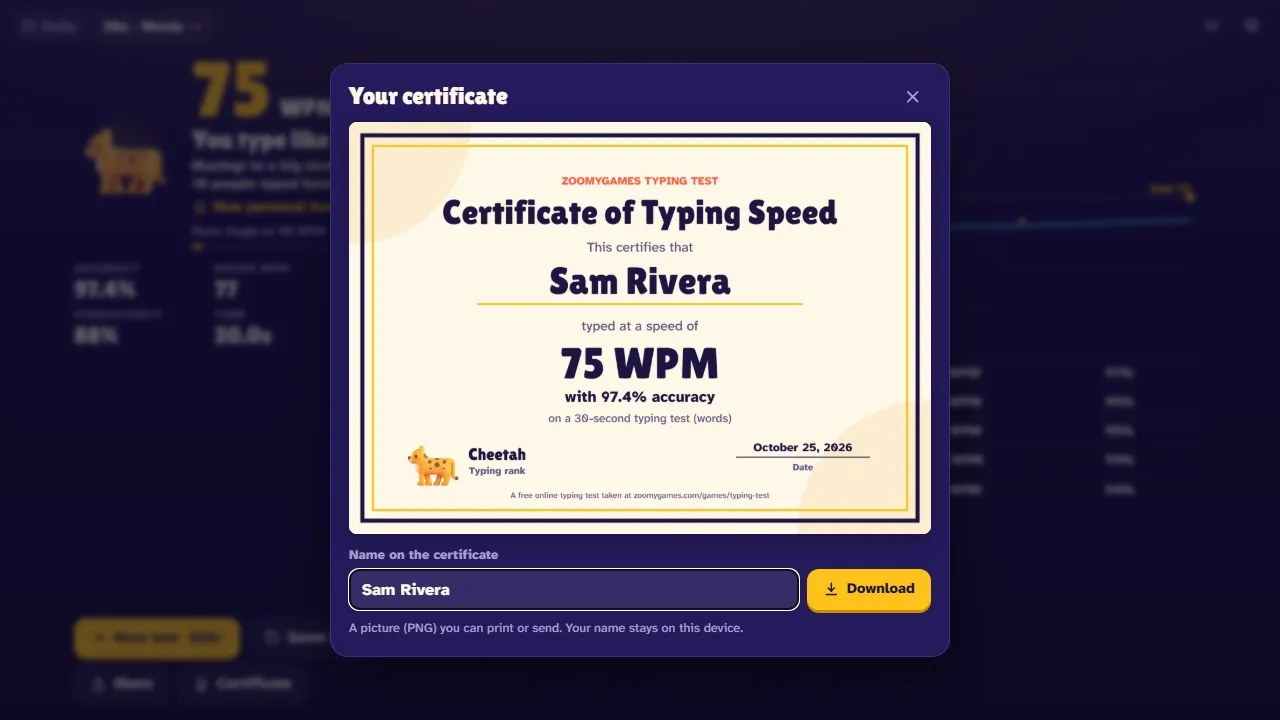
After a test, press Certificate, type your name and download a certificate with your speed, accuracy, test length and date. It's a picture you can print, add to a school folder or send to a friend. It's free, and it shows what you typed on this test; it isn't an official exam result.
What is a good typing speed?
It depends on what you need it for, but real numbers help:
- 40 WPM is a solid everyday speed, and it's what many U.S. government office jobs ask for (OPM).
- About 50 WPM is average. In a study of about 168,000 people who took an online typing test, the average speed was 52 WPM (Dhakal and others, 2018).
- Above 78 WPM puts you in the fastest 1 in 10 of that study, and its fastest typists reached 120 WPM or more.
- Court reporters must pass tests at up to 225 WPM with 95% accuracy, but they use a stenotype machine that types whole words with key combinations (NCRA).
Accuracy matters as much as speed: aim for 95% or more. In the big typing study, fast typists also made fewer mistakes, because fixing errors takes time.
Average typing speed
| Who was measured | Average speed | Source |
|---|---|---|
| Adults on a computer keyboard (about 168,000 people) | 52 WPM | Dhakal and others, 2018 |
| The fastest 1 in 10 of them | 78 WPM or more | Dhakal and others, 2018 |
| People typing on a phone (about 37,000 people) | 36 WPM | Palin and others, 2019 |
| Phone, two thumbs / one finger | 38 / 29 WPM | Palin and others, 2019 |
| Phone, ages 10 to 19 / in their 50s | 40 / 26 WPM | Palin and others, 2019 |
| U.S. fifth graders after a year of keyboarding lessons | 12 to 16 WPM | Donica and others, 2019 |
You may have read that the average person types 40 words per minute. We couldn't find a study behind that number. The largest study we know of found 52 WPM, among people who chose to take a typing test online.
Does typing speed drop with age? On phones, younger people were faster in the big phone study. On computer keyboards, a classic study of typists aged 19 to 72 found that experienced older typists were not slower than younger ones: they seemed to make up for it by reading further ahead (Salthouse, 1984).
How WPM and accuracy are calculated
In typing tests, a word is any 5 characters, counting spaces and punctuation. Typing tests have used this rule since the early 1900s, and it makes long and short words count fairly (MacKenzie, York University). This test works out:
- Net WPM, your main score: the characters you typed correctly, divided by 5, per minute. Mistakes you leave in don't count.
- Gross WPM (raw speed): every character key you pressed, right or wrong, divided by 5, per minute.
- CPM: correct characters per minute (net WPM × 5).
- Accuracy: the keys you got right, out of all the character keys you pressed. A mistake you fix still counts as a mistake.
- Consistency: how steady your speed was from second to second. 100% would mean exactly the same speed every second.
For example, in a 1-minute test you type 250 characters correctly and 10 wrong. Your net speed is 250 ÷ 5 = 50 WPM, your gross speed is 260 ÷ 5 = 52 WPM, and your accuracy is 250 ÷ 260 = 96%.
Another typing test may give a slightly different number for the same typing. There's no single official formula for net WPM, and tests take off mistakes in different ways (Keith and Ericsson, 2007).
Screenshots

The typing test ready to go: a 1-minute test with common words, the timer and the speedometer 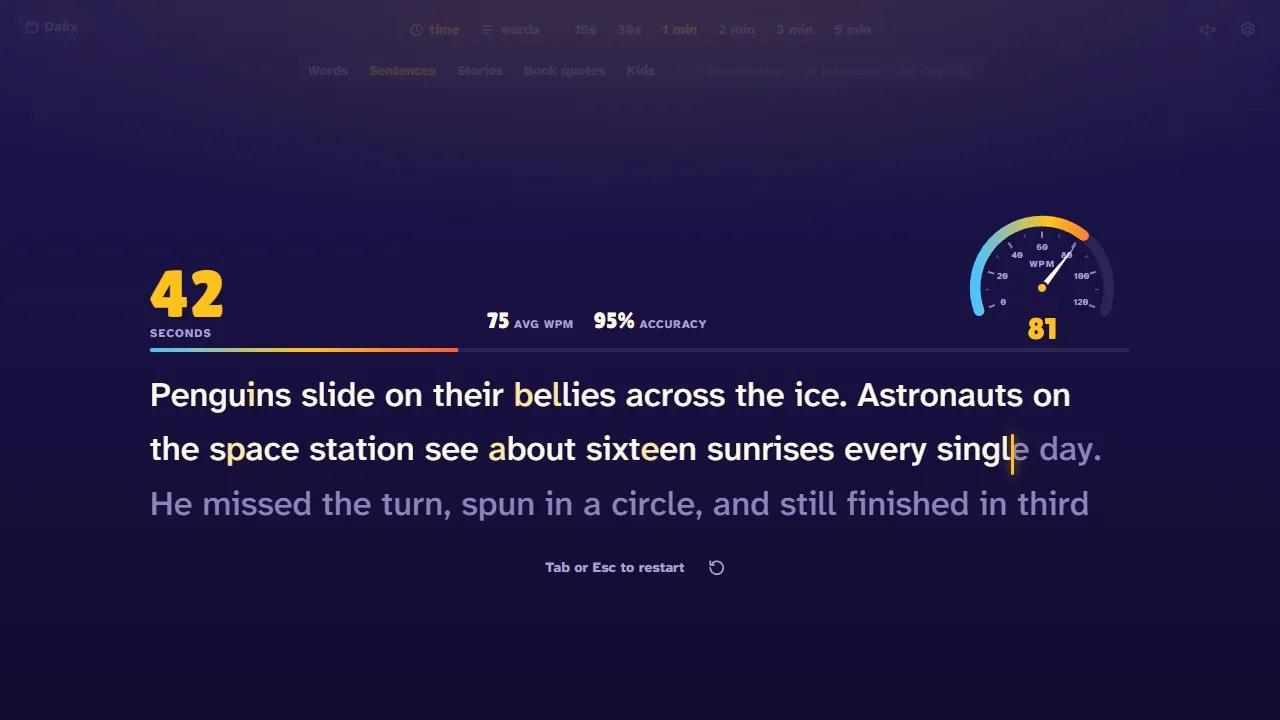
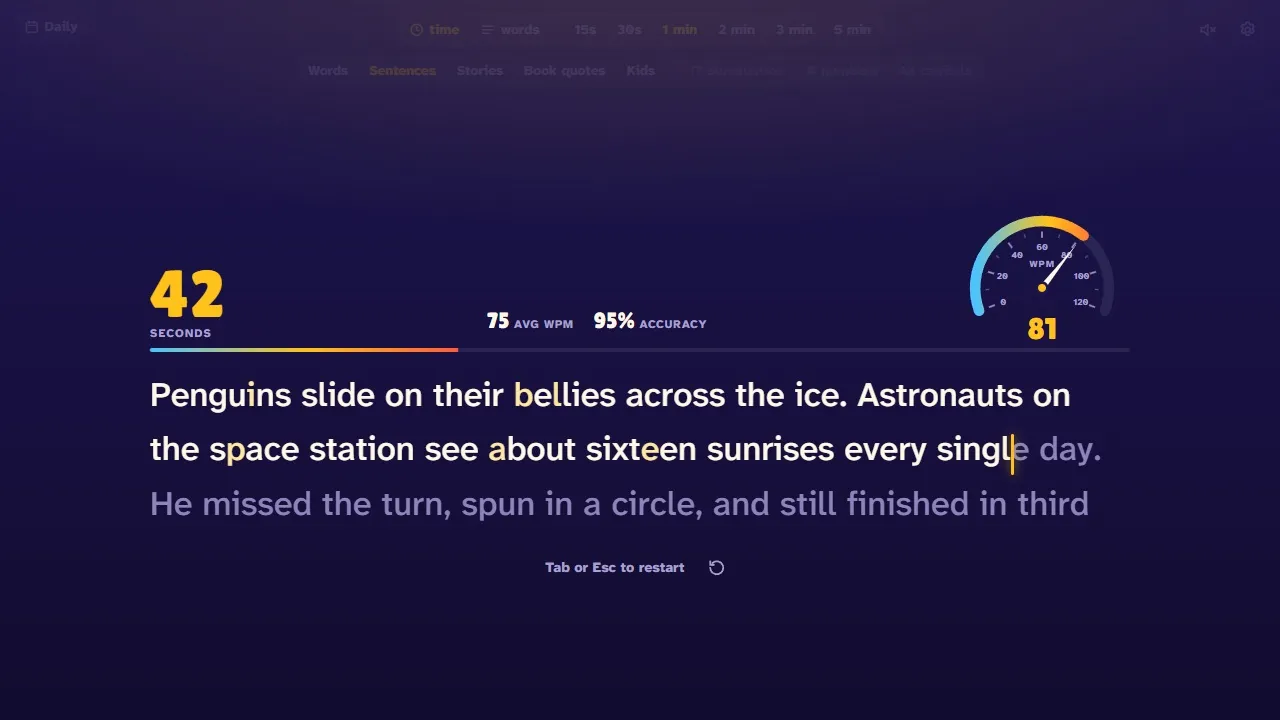
Halfway through a 1-minute sentence test, with live WPM, accuracy and the speedometer, and mistakes marked in red 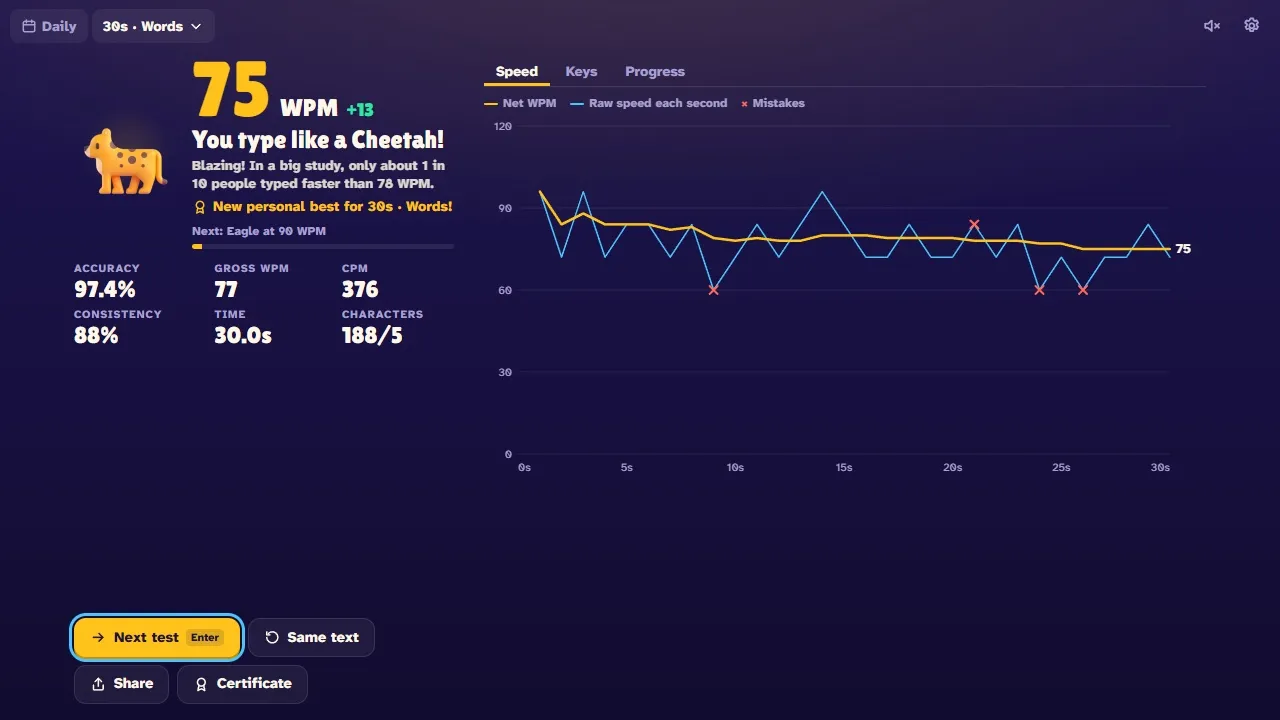
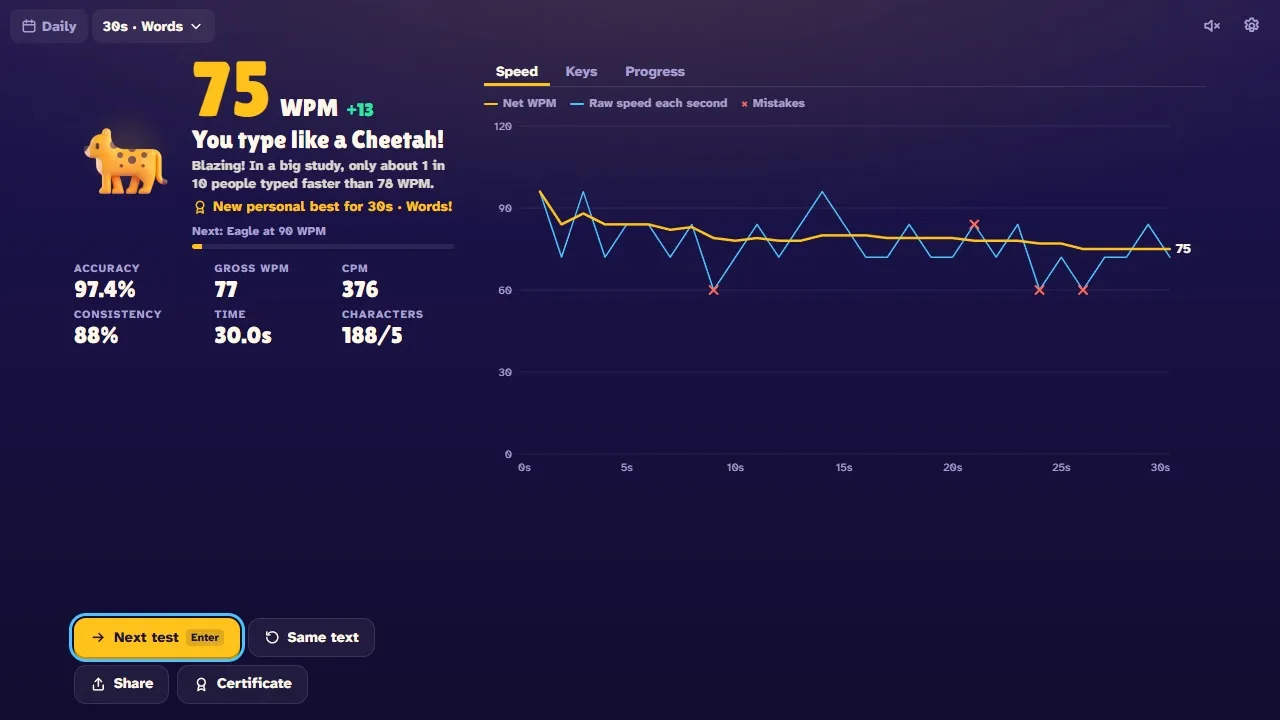
Typing test results: 75 WPM with 97.4% accuracy, the Cheetah speed rank and a chart of every second 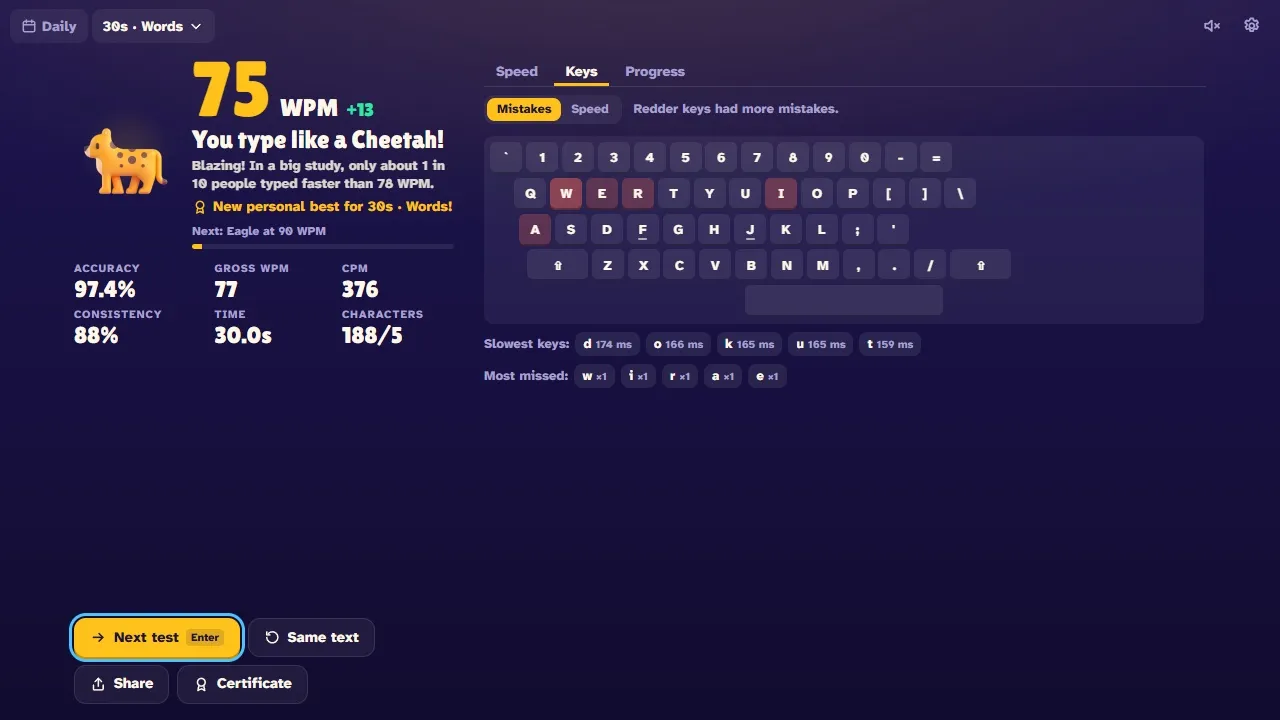
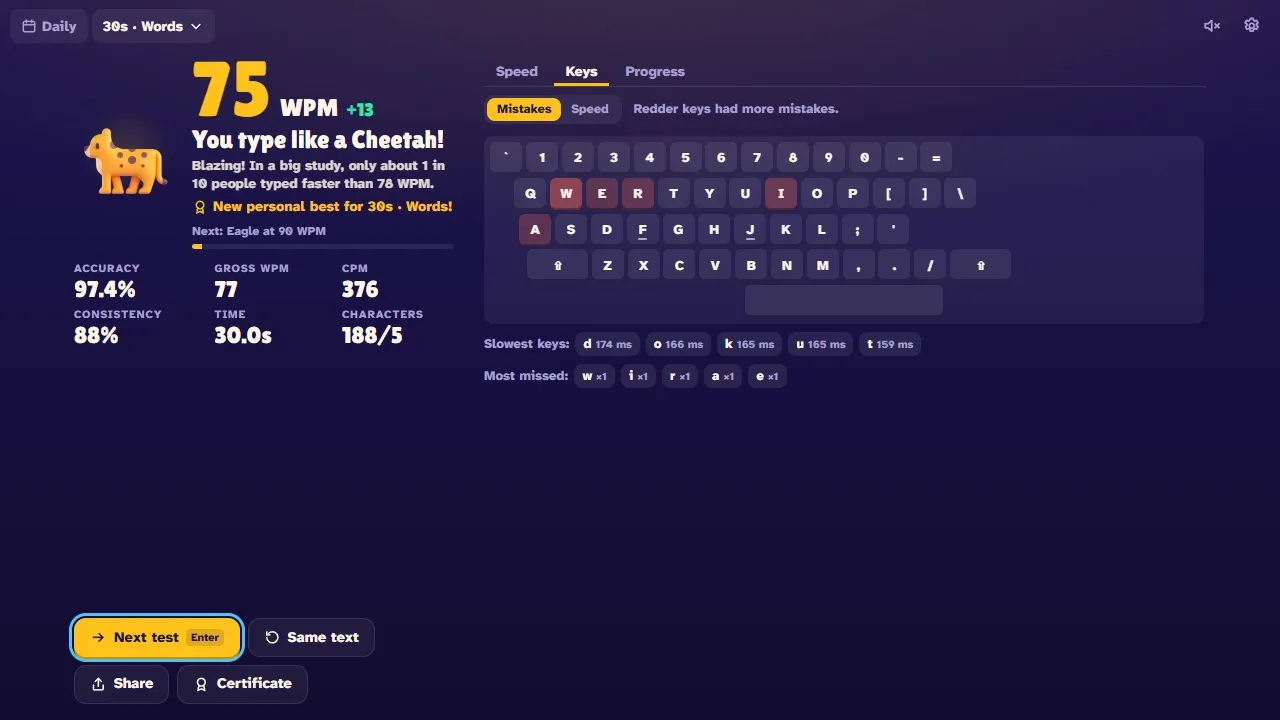
A keyboard heatmap of the keys with mistakes, and the slowest and most-missed keys 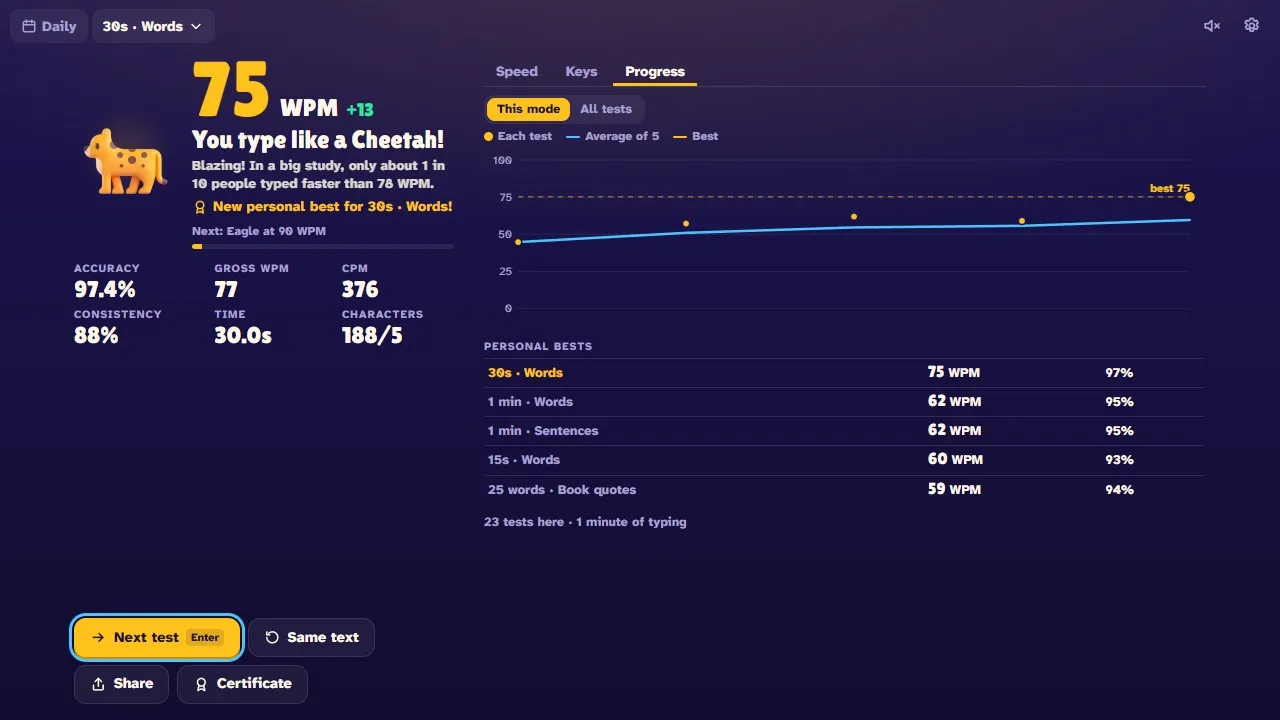
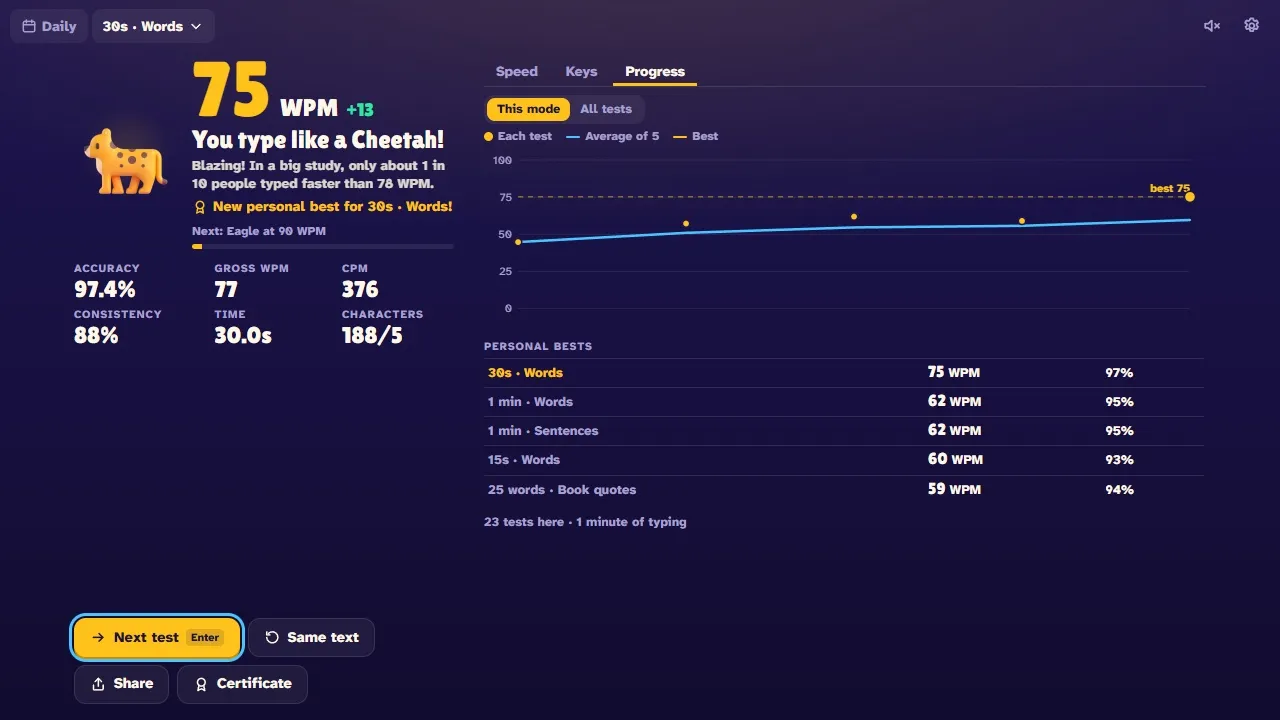
The progress chart and personal bests for each kind of test 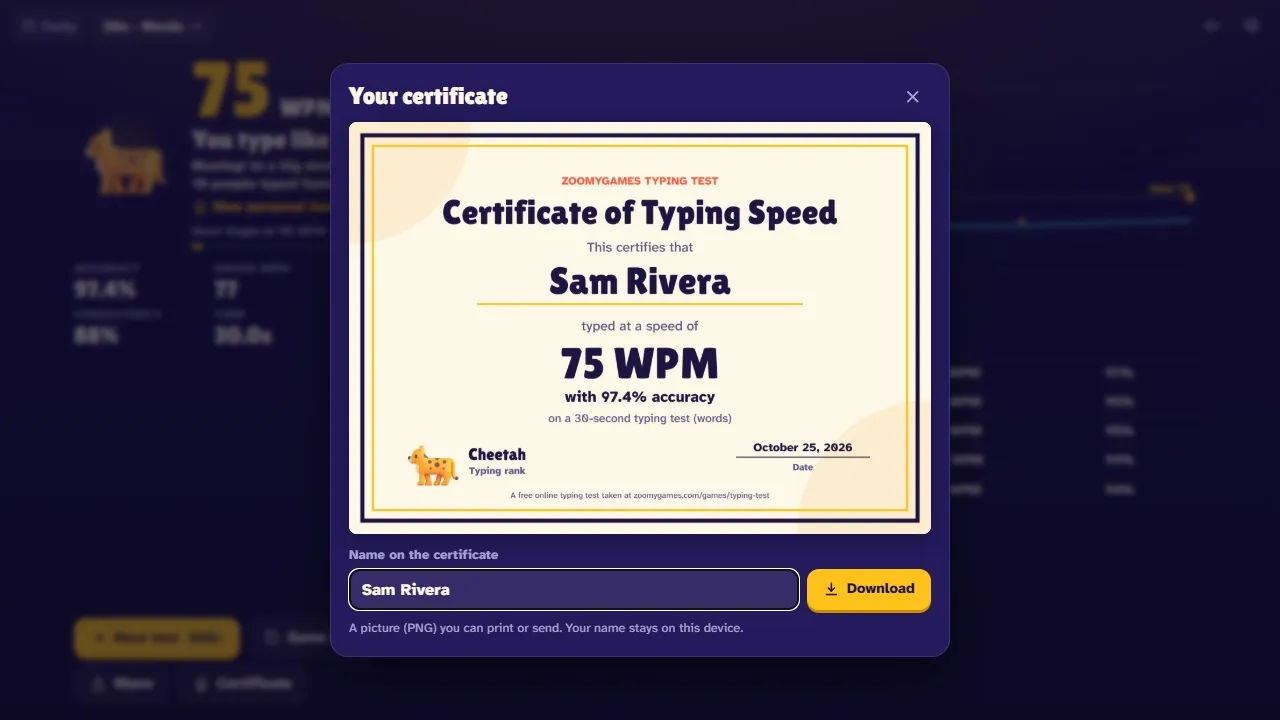
A free typing certificate with a name, the typing speed, accuracy and date

How to take the typing test
- 1
Just start typing
The words are already on the screen. Type them and the clock starts with your first key. On a phone, tap the text first.
- 2
Mistakes turn red
Fix a mistake with Backspace or keep going. The space bar moves to the next word.
- 3
Pick your test
Choose time (15 seconds to 5 minutes) or words (10 to 100), and what to type: words, sentences, stories, book quotes or kids' words.
- 4
See your results
Get your WPM, accuracy, speed chart, keyboard heatmap and rank. Press Enter for the next test.
Controls
| Input | What it does |
|---|---|
| Type | Type the text; the clock starts with your first key |
| Space | Move to the next word (letters you skip count as mistakes) |
| Backspace | Delete the last letter (Ctrl+Backspace: the whole word) |
| Tab or Esc | Restart with a new text |
| Enter | Next test (on the results) |
| Tap the text (phones) | Open your keyboard and start |
What you get
- Ready the moment the page opens: just start typing
- Tests from 15 seconds to 5 minutes, or from 10 to 100 words
- Words, sentences, Aesop's fables, classic book quotes and a kids mode
- Punctuation, numbers and capital letters for a harder test
- Net and gross WPM, CPM, accuracy and consistency
- A speed chart, your slowest keys and a keyboard heatmap
- Personal bests and progress, saved in your browser
- A daily test with the same text for everyone, and a streak
- Speed ranks from Snail to Rocket, a share card and a free certificate
- Works on computers, Chromebooks, tablets and phones, in dark or light
How to type faster
Make fewer mistakes
Slow down a little until your accuracy is 95% or more. In a big typing study, fast typists also made fewer mistakes, because fixing errors takes time.
Use the same finger for each key
You don't need all ten fingers to type fast: in a lab study, self-taught typists were about as fast as touch typists. What fast typists share is using the same finger for the same key every time (Feit and others, 2016).
Look at the screen, not the keys
Touch typists in the same study spent about half as much time looking down at the keyboard. Learn where the keys are and trust your fingers.
Read ahead
Keep your eyes a word or two ahead of the cursor, so your fingers always know what comes next.
Practise a little, often
A few short tests a day beat one long session. In one study, the fastest typists had taken a typing class and also tried to type quickly in everyday life (Keith and Ericsson, 2007).
Learn touch typing with a game
Keytona's career teaches touch typing one row at a time while you race. You may get slower at first while you switch: in one study, students typed faster three months after a touch typing course than before it (Weigelt Marom and Weintraub, 2015). Play Keytona.
Frequently asked questions
What is a good WPM?
About 40 WPM is a good everyday speed, and 50 to 60 WPM is around average or a little above. In a study of about 168,000 people who took an online typing test, the average was 52 WPM and the fastest 1 in 10 typed more than 78 WPM (Dhakal and others, 2018). Accuracy matters too: aim for 95% or more.
What is the average typing speed?
In the largest study we know of, about 168,000 people who took an online typing test averaged 52 words per minute on a computer keyboard. On phones it's slower: about 37,000 people averaged 36 WPM (Palin and others, 2019).
Is 40 WPM a good typing speed?
Yes. 40 WPM is a solid speed for everyday typing, and it's what many U.S. government office jobs ask for, on a 5-minute test with no more than 3 errors (OPM). It's a little below the 52 WPM average of the big typing study, so with some practice you can go further.
What typing speed do I need for a job?
It depends on the job. Many U.S. government office and clerk jobs ask for 40 WPM on a 5-minute test with no more than 3 errors. Other employers set their own levels, so check the job listing, then practise with the 5-minute test here.
How is WPM calculated, and what is CPM?
A word is any 5 characters, including spaces. Net WPM is the characters you typed correctly, divided by 5, per minute. Gross WPM counts every key you pressed. CPM (characters per minute) is net WPM × 5. Accuracy is the share of keys you got right.
What is a good typing speed for kids?
There's no official target for each age. In one U.S. study of about 1,700 elementary students, fifth graders typed about 12 to 16 WPM by the end of the school year (Donica and others, 2019). Any speed is a good start: the Kids mode and its animal ranks make practice fun.
What is the fastest typing speed ever recorded?
Guinness World Records lists Stella Pajunas, who typed 216 words in one minute on an IBM electric typewriter in 1946 (Guinness World Records). Online typing sites show higher scores for short tests, but nobody checks those officially.
How can I type faster?
Practise a little every day, keep your eyes on the screen, use the same finger for each key, and slow down until you make few mistakes. The tips above have more, and Keytona teaches touch typing while you race.
Can I get a typing certificate?
Yes. After any test, press Certificate, add your name and download it as a picture to print or share. It's free. It records your result on this test; it isn't an official exam.
Does the typing test work on a phone, tablet or Chromebook?
Yes. On a Chromebook or computer, just start typing. On a phone or tablet, tap the text to open your keyboard: the test goes full screen so the keyboard doesn't cover the words. Typing on a phone is slower for everyone, so compare phone scores with phone scores.
Are my results saved?
Yes, your personal bests, history and settings are saved in your browser on this device. There's no account. Clearing your browser data resets them.
What's new
- The typing test is out: tests from 15 seconds to 5 minutes, five kinds of text, a daily test, speed ranks from Snail to Rocket and a free certificate