
About this reaction time test
This free reaction time test measures how fast you react to something you see. It's ready the moment the page opens: tap the big button (or press any key) to start, wait for the screen to turn green, then tap as fast as you can. Do that five times and you get your average reaction time in milliseconds, your fastest and slowest try, a fun speed rank from Koala to Housefly, and how you compare with adults in a published study.
A reaction time test is simple, but the timing has to be right. This one listens for the moment your finger or key goes down (not when you let go), times the green screen from when it is actually drawn, and throws out guesses: tap before green and it's a false start, tap within 0.1 seconds and it's a lucky guess, the same rule sprinters race under. Every try gets a fresh random wait, so you can't count it out.
Then test your reflexes in other ways, each with its own best score. Outdraw eight outlaws in a Western Duel without being fooled by a crow. Dive the right way to save penalties as Goalkeeper. Get away when the five Start Lights go out. React to a beep with your eyes closed in Sound Reaction. Hit 20 targets in the Aim Trainer, or catch a falling metre stick in the Ruler Drop. There's a Daily challenge with the same waits for everyone, and a link to challenge a friend.
It works on computers, Chromebooks, tablets and phones, with a mouse, a touchscreen or a keyboard. Your bests and progress are saved in your browser. No sign-up, no download.
Reaction Time Test videos from creators
For YouTubers, TikTokers and streamers
Make a Reaction Time Test video. We'll feature it right here.
Post your gameplay on YouTube, TikTok, Instagram, Twitch or anywhere else, then send us the link. We watch every video, and our favorites go on this page with your name and a link to your channel, in front of everyone who comes to play Reaction Time Test.
- Every view counts on your channel. We embed your video, we never re-upload it.
- Small channels welcome. You don't need followers, just a fun video.
- Videos and streams of 3 minutes or more, on YouTube, Twitch, TikTok or Instagram.
- Free, and no sign-up needed.
Ideas, rules and every featured video: ZoomyGames for creators
Reflex games: six more ways to test your reactions
Open the menu (the button at the top left of the test) to switch. Each game tests a different kind of reaction:
- Classic: tap when the screen turns green. A simple visual reaction time test, 5 tries.
- Western Duel: when DRAW! appears, tap before the outlaw fires. Eight outlaws, from Sleepy Sam (about 0.48 seconds) to The Ghost (about 0.24 seconds). Later outlaws send a crow, a tumbleweed or a twitchy hand to make you draw too early.
- Goalkeeper: a choice reaction test. The striker shoots left or right and you dive the same way. Dive before the kick and the striker shoots the other way. 10 penalties, each a little faster.
- Start Lights: five red lights come on one by one, then all go out together. Go! Jumping before the lights are out is a jump start.
- Sound Reaction: nothing on the screen changes. Listen for the beep and tap. Try it with your eyes closed.
- Aim Trainer: 20 targets appear one at a time, anywhere on the screen. Your score is the average time per target, plus your accuracy.
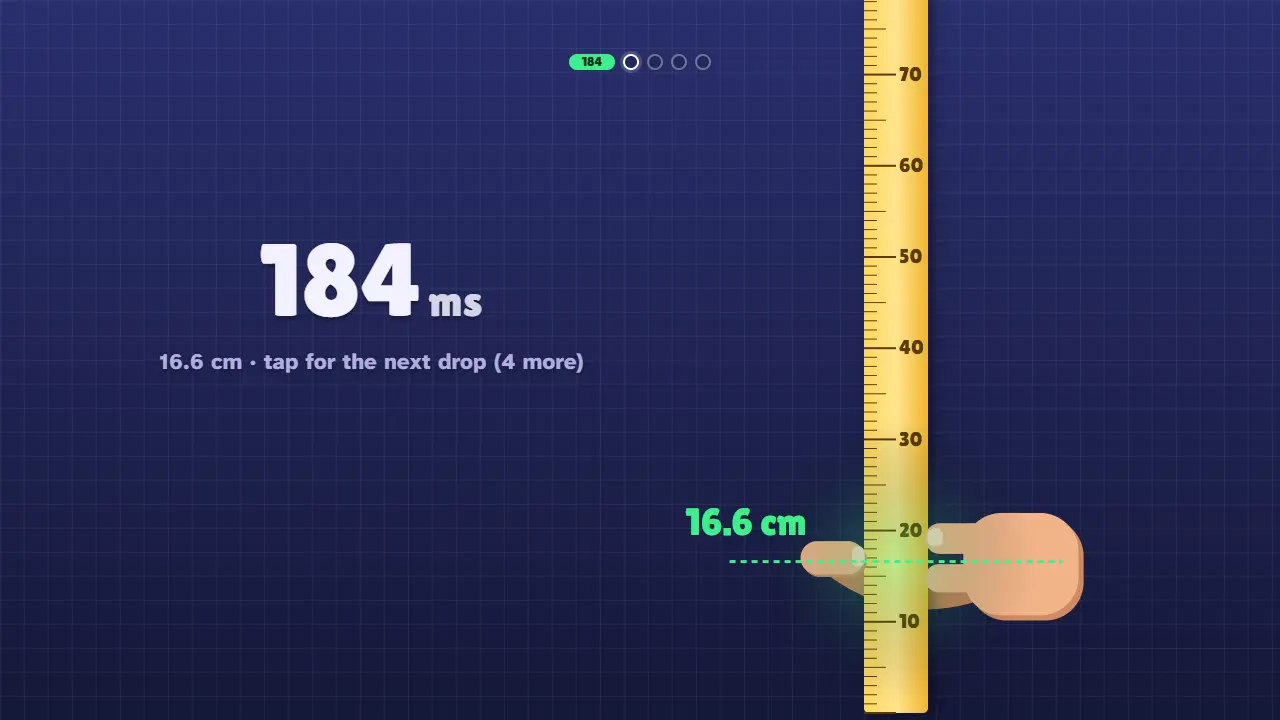
- Ruler Drop: a metre stick drops between your fingers. Catch it and see how far it fell in centimetres, and what that means in milliseconds.
Want to test other skills? See how many clicks per second you can do in the CPS Test, or check how fast you type with our Typing Test.
What is the average human reaction time?
For a simple reaction to something you see, adults in the lab take about a quarter of a second. In one of the largest studies, 1,469 adults aged 18 to 65 averaged 231 milliseconds, and most people were within about 27 ms of that (Woods and others, 2015).
| What was measured | Average | Source |
|---|---|---|
| Adults reacting to a light, on lab equipment | 231 ms | Woods and others, 2015 |
| The same, without the 18 ms the lab's screen and mouse added | 213 ms | Woods and others, 2015 |
| Youngest group / oldest group in that study | 218 / 239 ms | Woods and others, 2015 |
| Classic textbook values: reacting to a sound / a light | 140–160 / 180–200 ms | BioNumbers, Harvard |
| Extra delay a web browser and home device can add | about 80 ms on average, up to 100 ms | Anwyl-Irvine and others, 2021 |
So what is a good reaction time on this test? On a normal screen with a mouse or touchscreen, an average between about 250 and 300 ms is typical, under 250 ms is quick, and under 200 ms is very fast. Phones and wireless mice tend to add a little delay, so compare your scores on the same device.
Our comparison ("faster than about X% of adults") uses the 1,469 adults from the Woods study, with 50 ms added for a typical home screen and input, because home devices are slower than lab equipment. That 50 ms is our own estimate inside the range studies have measured, and we label it on the results. We don't invent player numbers.
What affects your reaction time?
- What you react to. Most people react a little faster to a sound than to a light. Try Classic and then Sound Reaction and compare.
- How many choices you have. Picking between options takes longer than a single "go": the more choices, the slower the reaction. That's called Hick's law (Hick, 1952), and it's why Goalkeeper times are slower than Classic times.
- Age. In the Woods study, reaction time grew by about half a millisecond for every year of age, from about 218 ms in the youngest group to 239 ms in the oldest. Men and women were about equally fast, and left- and right-handed people too.
- How alert you are. Losing sleep hurts simple attention more than any other kind of thinking studied in a large review (Lim and Dinges, 2010): tired people have more slow, "zoned out" reactions.
- Focus. Distractions, a noisy room or checking your phone between tries all slow you down. Even a long session can: people in the Woods study were a few milliseconds slower at the end than at the start.
- Your device. Your screen, mouse or touchscreen and browser all add a little delay before the game can see your tap (see below).
This test is for fun and practice. It can't tell you anything about your health.
How the test is timed (and why devices differ)
Each try waits a random time, at least 1.5 seconds, before the signal. The game times the signal from when the green frame is actually sent to your screen, and your reaction from the moment the mouse button, key or finger goes down. Tap before the signal and it's a false start; tap less than 100 ms after it and it counts as a guess. In athletics, a sprinter who moves within 0.1 seconds of the gun is disqualified for a false start (World Athletics rule).
No web page can see the exact moment light leaves your screen. Screens take a few milliseconds to show a new picture, wireless mice and touchscreens take time to report a tap, and browsers add a little more. In tests of web browsers and devices, response times were recorded about 80 ms late on average, and up to 100 ms on some set-ups (Anwyl-Irvine and others, 2021). A fast, wired gaming mouse and a high refresh rate screen will give you lower numbers than an older phone. That's why your progress chart is the best comparison: same device, same you.
Sound Reaction is timed from when the beep really reaches your speakers, using your browser's audio clock, so your sound card's delay is taken out where the browser reports it.
The ruler drop test
The ruler drop is a classic science class test: a friend holds a ruler between your open fingers and lets go without warning, and you catch it as fast as you can. The further it falls, the slower you were. Because a falling ruler speeds up with gravity, the distance tells you the time: time = √(2 × distance ÷ 9.81 m/s²).
| Distance fallen | Reaction time |
|---|---|
| 5 cm | 101 ms |
| 10 cm | 143 ms |
| 15 cm | 175 ms |
| 20 cm | 202 ms |
| 25 cm | 226 ms |
| 30 cm | 247 ms |
| 40 cm | 286 ms |
| 50 cm | 319 ms |
Our Ruler Drop uses a metre stick, so a slower catch still fits. A 30 cm school ruler would slip right through anyone slower than about a quarter of a second.
Aim trainer and aim test
The Aim Trainer adds aiming to reaction: a target pops up anywhere on the screen and you have to find it, move there and hit it. Your score is the average time per target over 20 targets, plus your accuracy (hits out of all your clicks). It's slower than a simple reaction, usually somewhere around 400 to 700 ms per target with a mouse, because finding and moving take time too. Play it with a mouse, a trackpad or your finger.
Screenshots
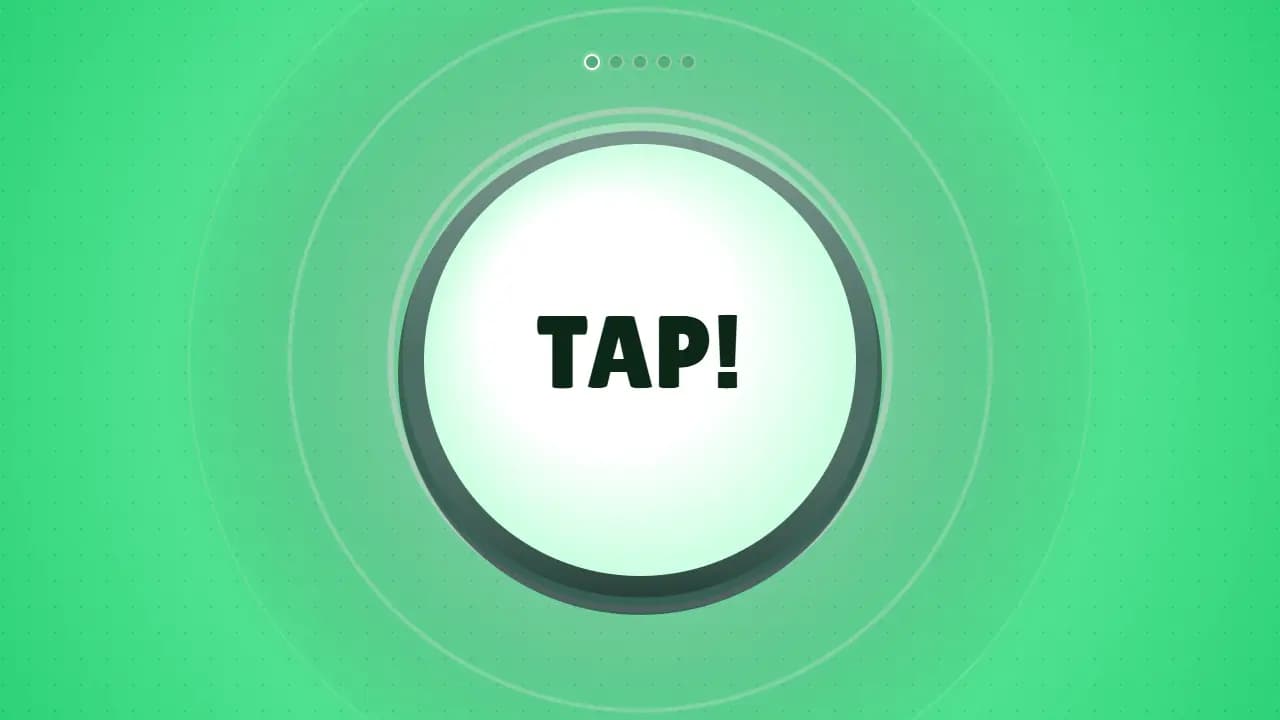
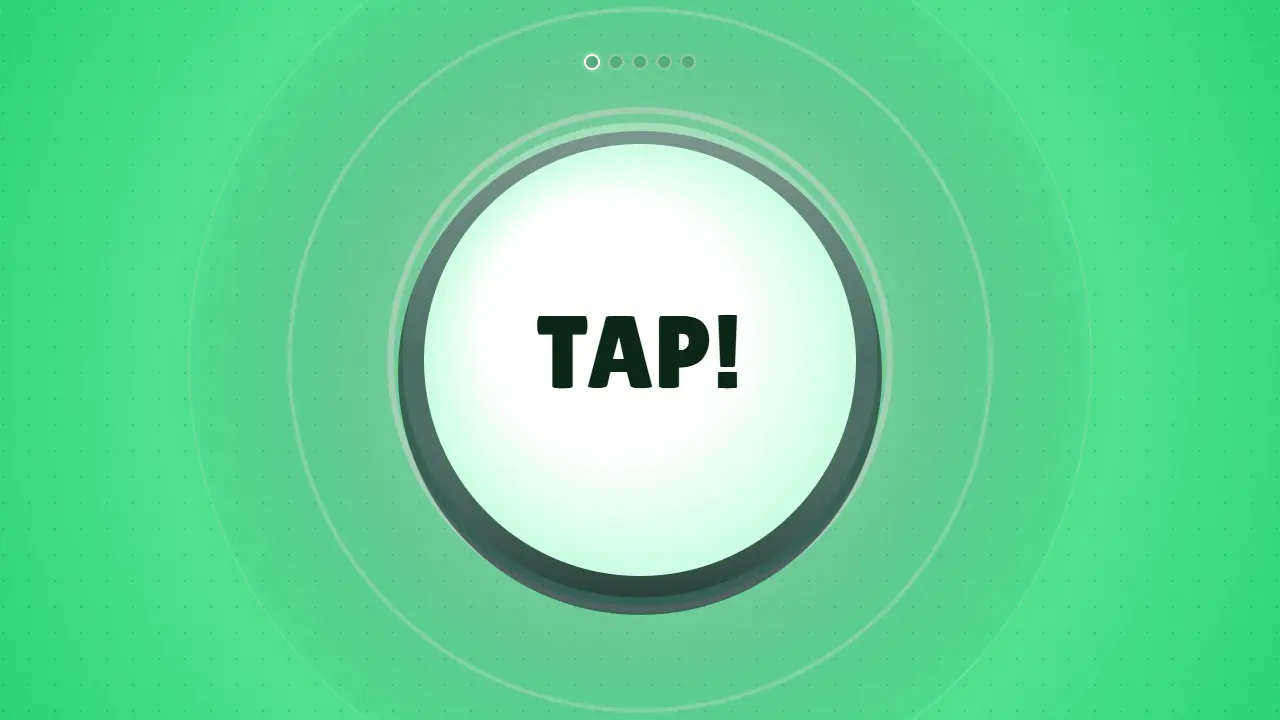
The reaction time test when the screen turns green: the big button says TAP! 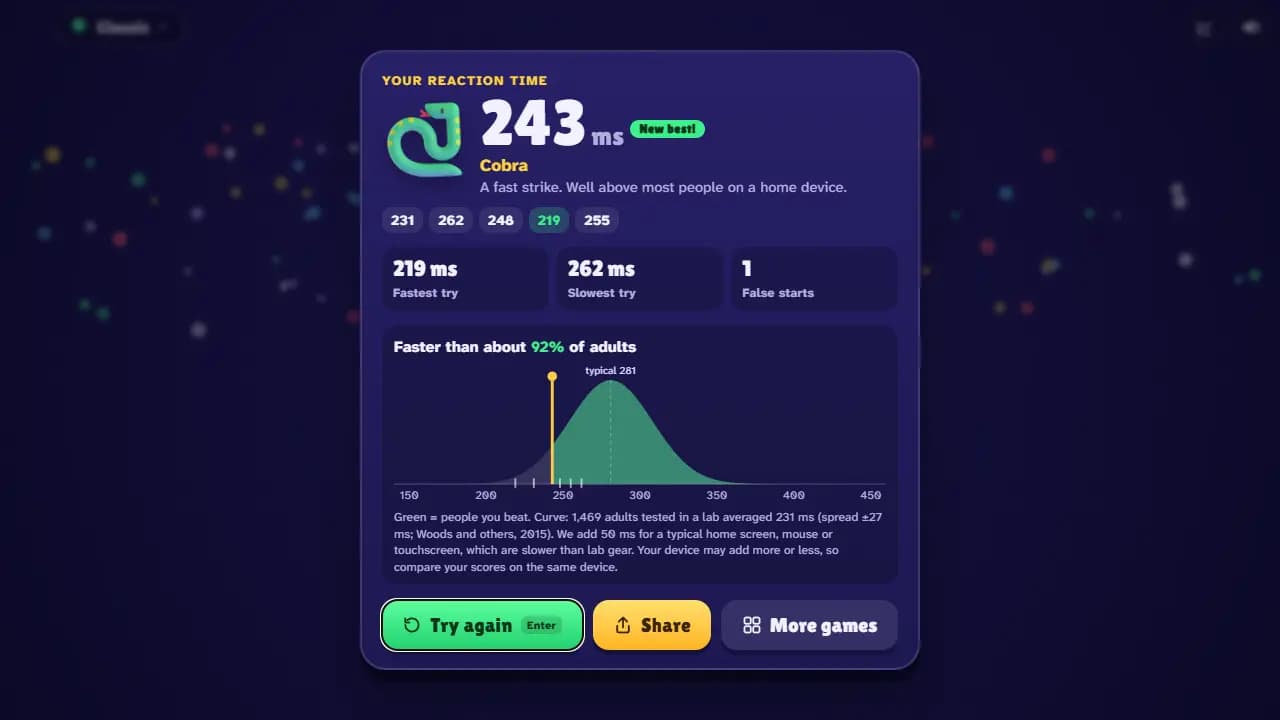
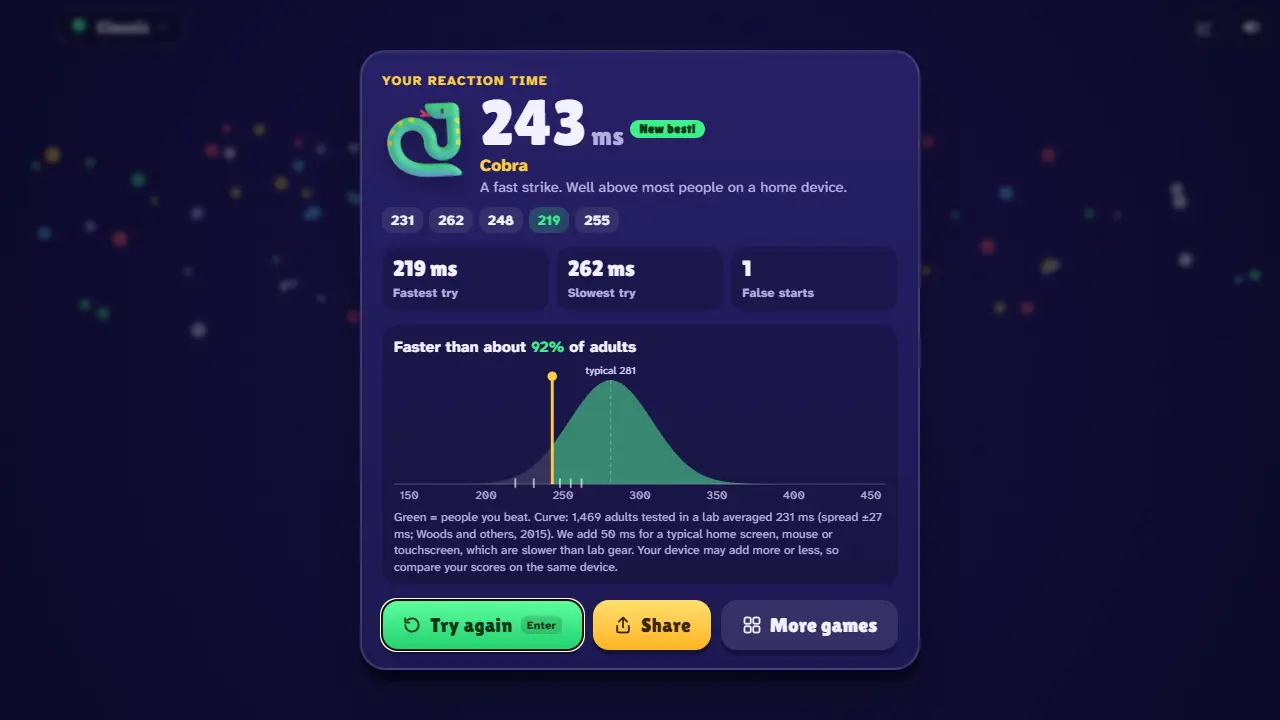
Reaction time test results: a 243 ms average, the Cobra rank, all five tries and a bell curve comparing the result with adults in a study 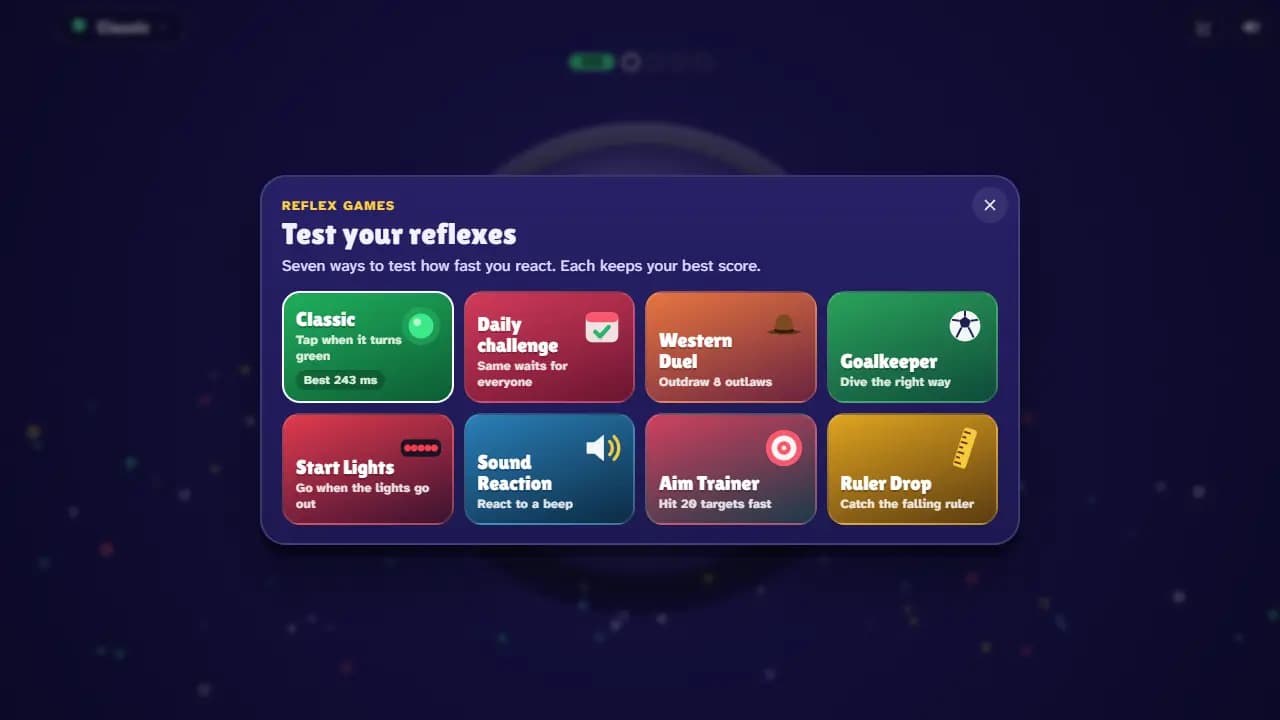
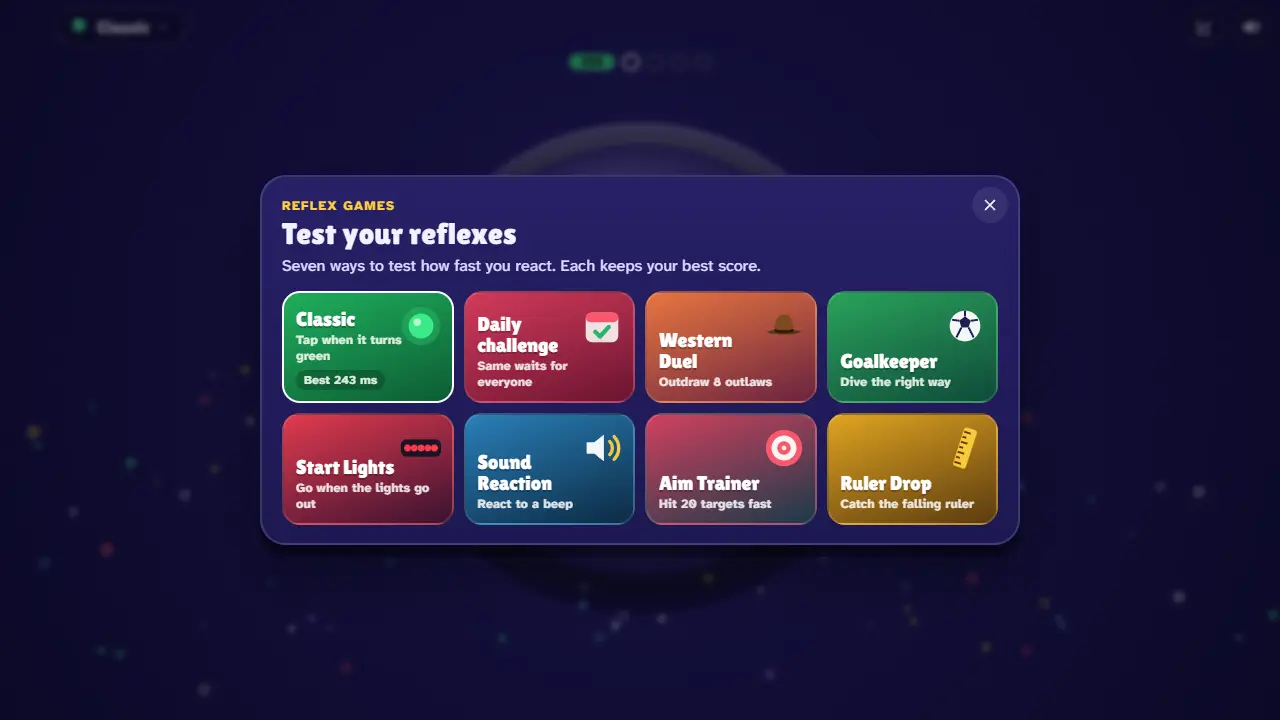
The reflex games menu: Classic, Daily challenge, Western Duel, Goalkeeper, Start Lights, Sound Reaction, Aim Trainer and Ruler Drop 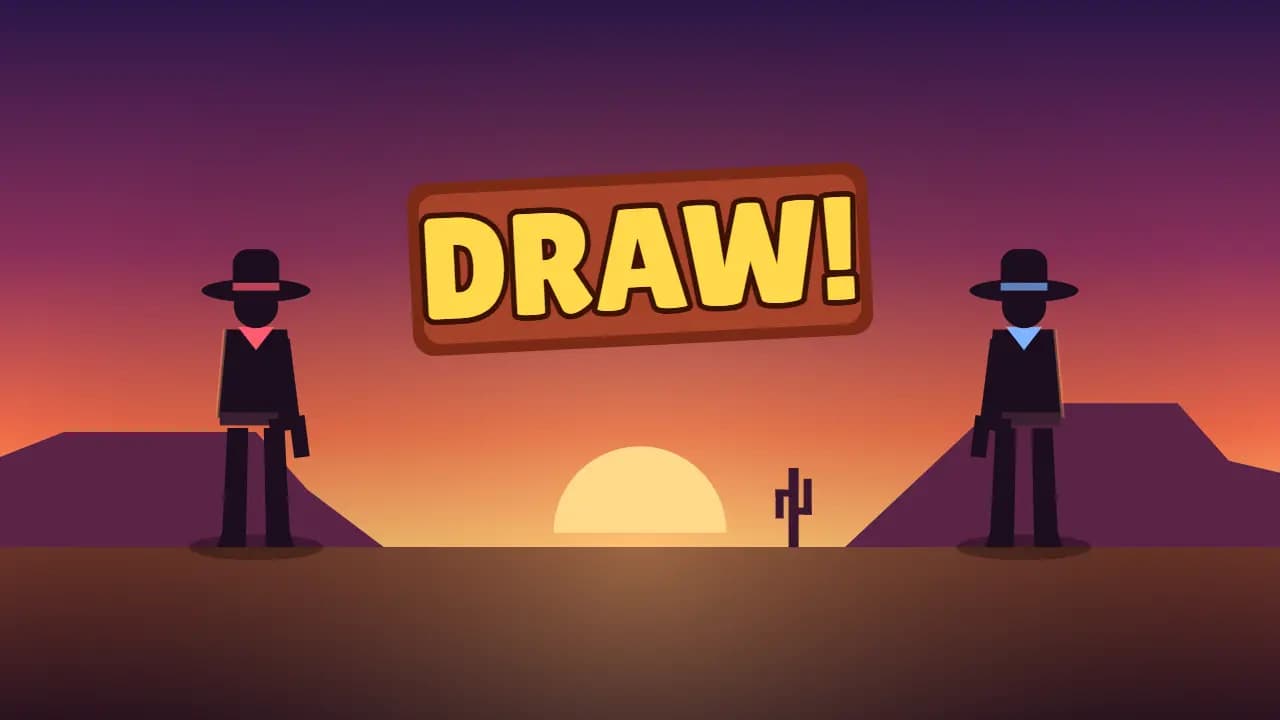
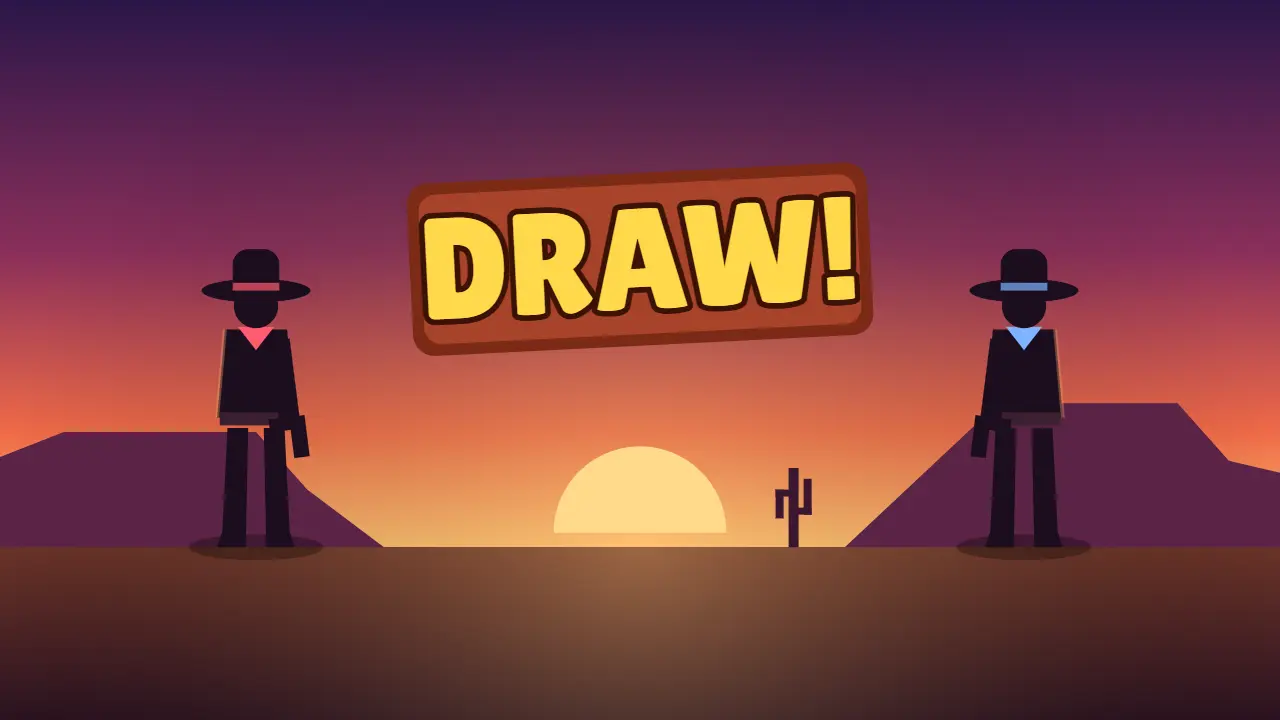
Western Duel: two gunslingers at sunset and a big DRAW! sign 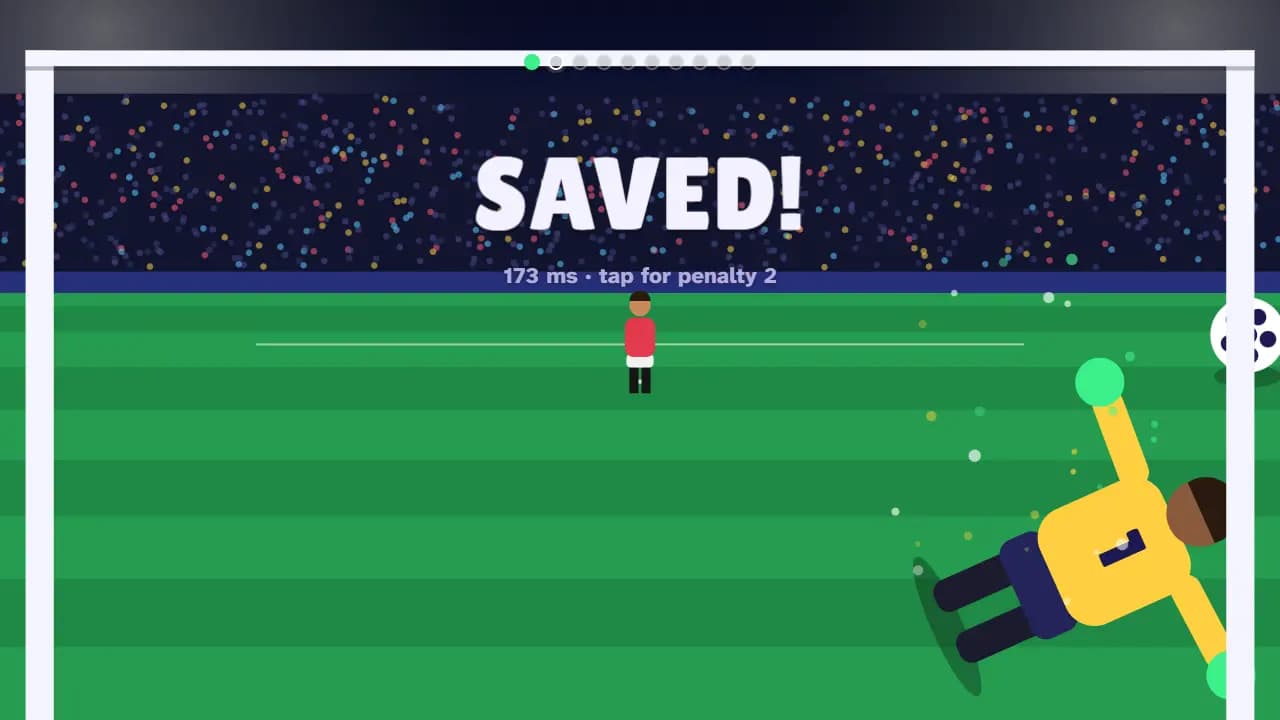
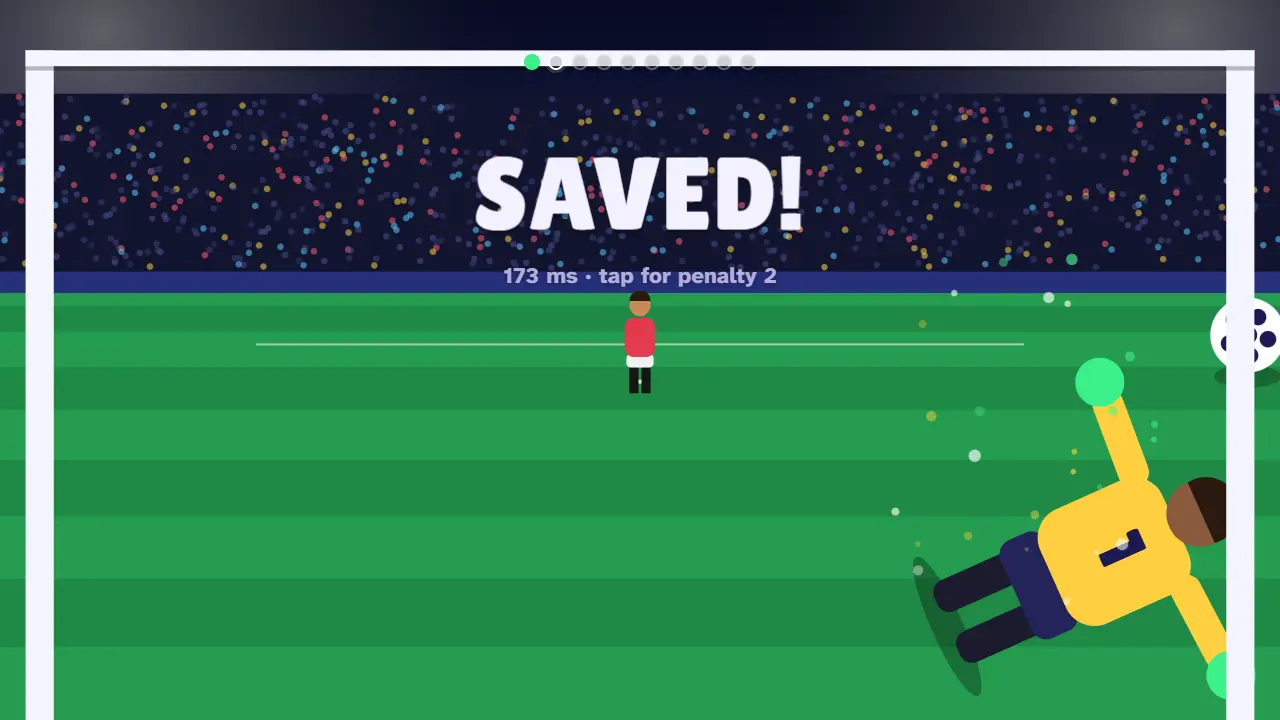
Goalkeeper reflex game: the keeper dives the right way and saves the penalty 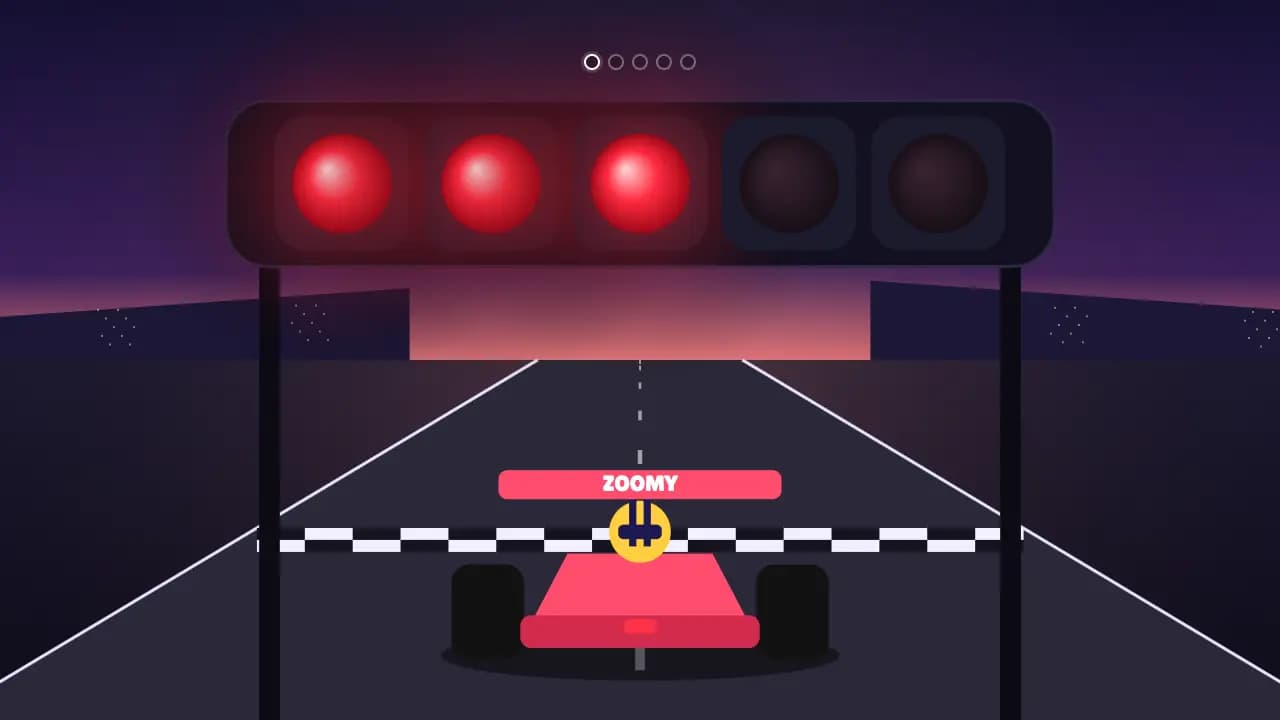
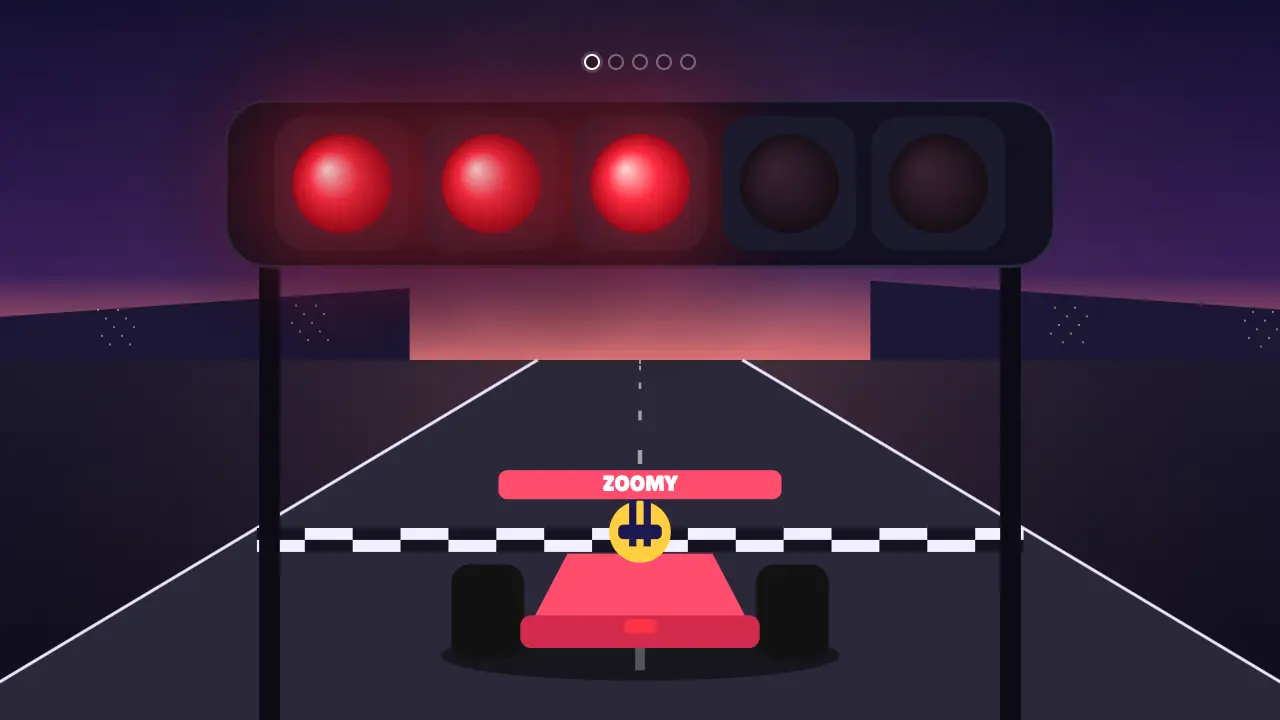
Start Lights: three of the five red start lights are on, with a race car on the grid 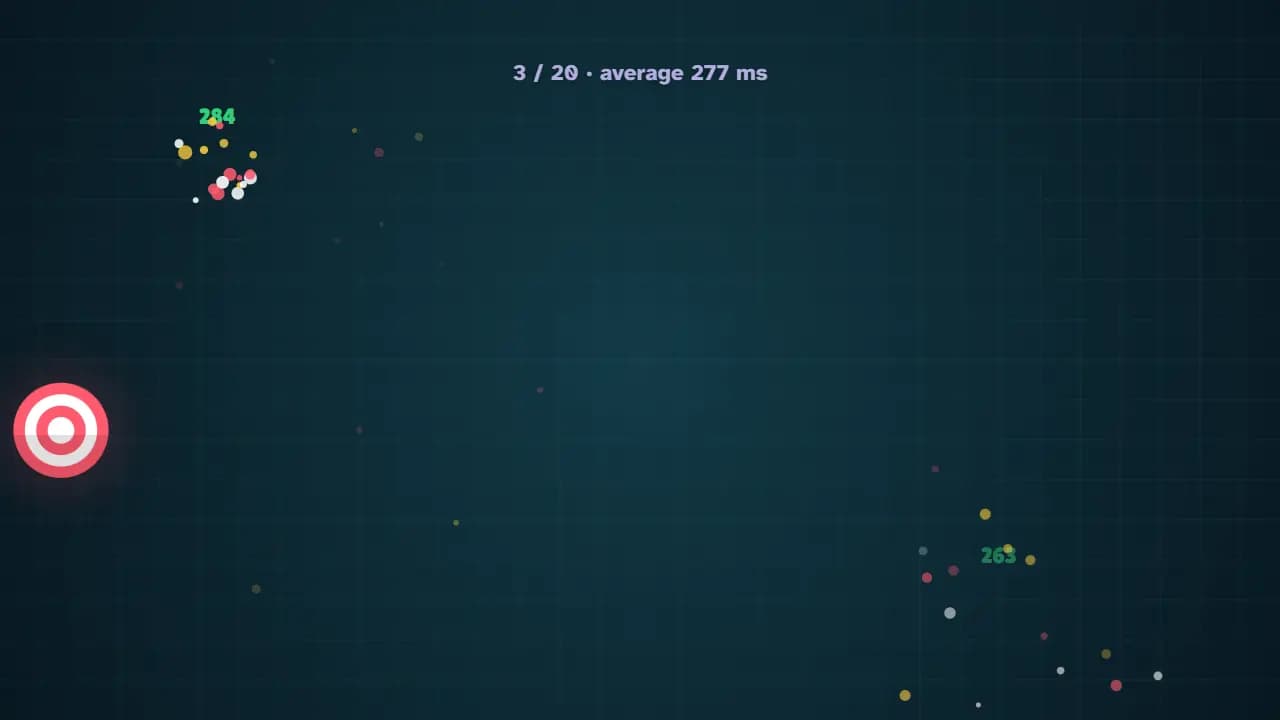
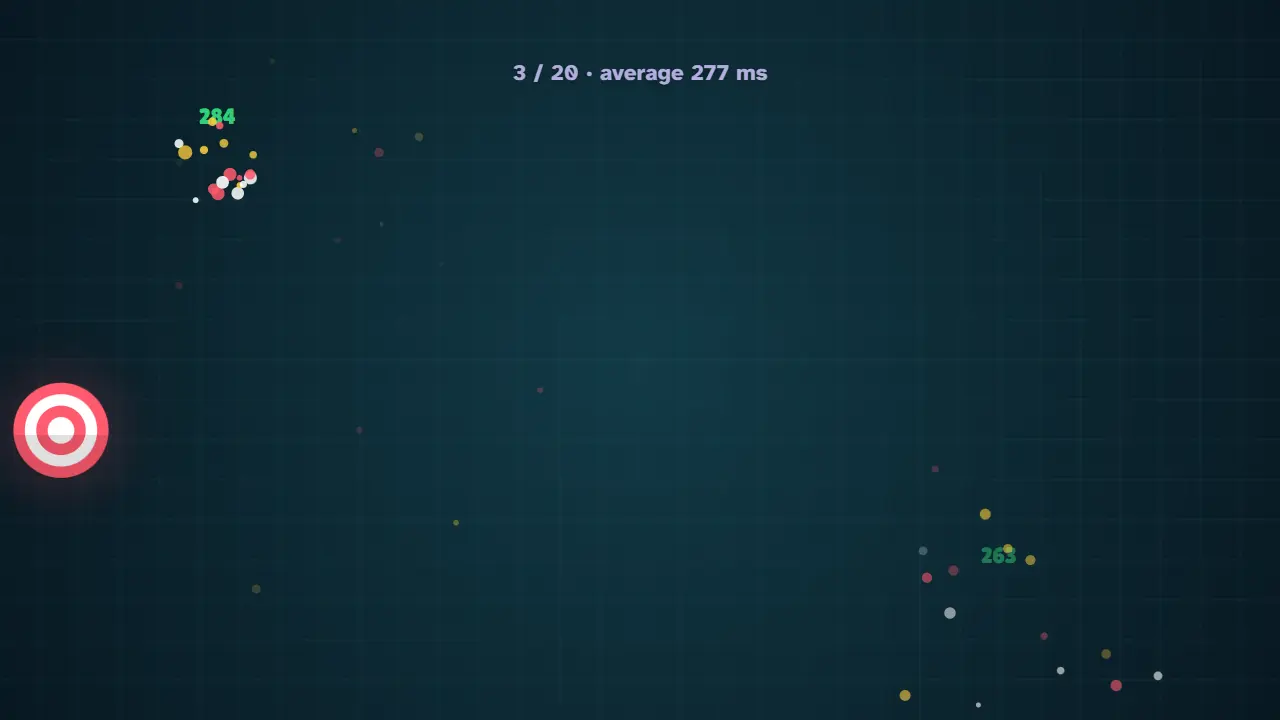
Aim Trainer: hitting targets one at a time, with the time for each hit 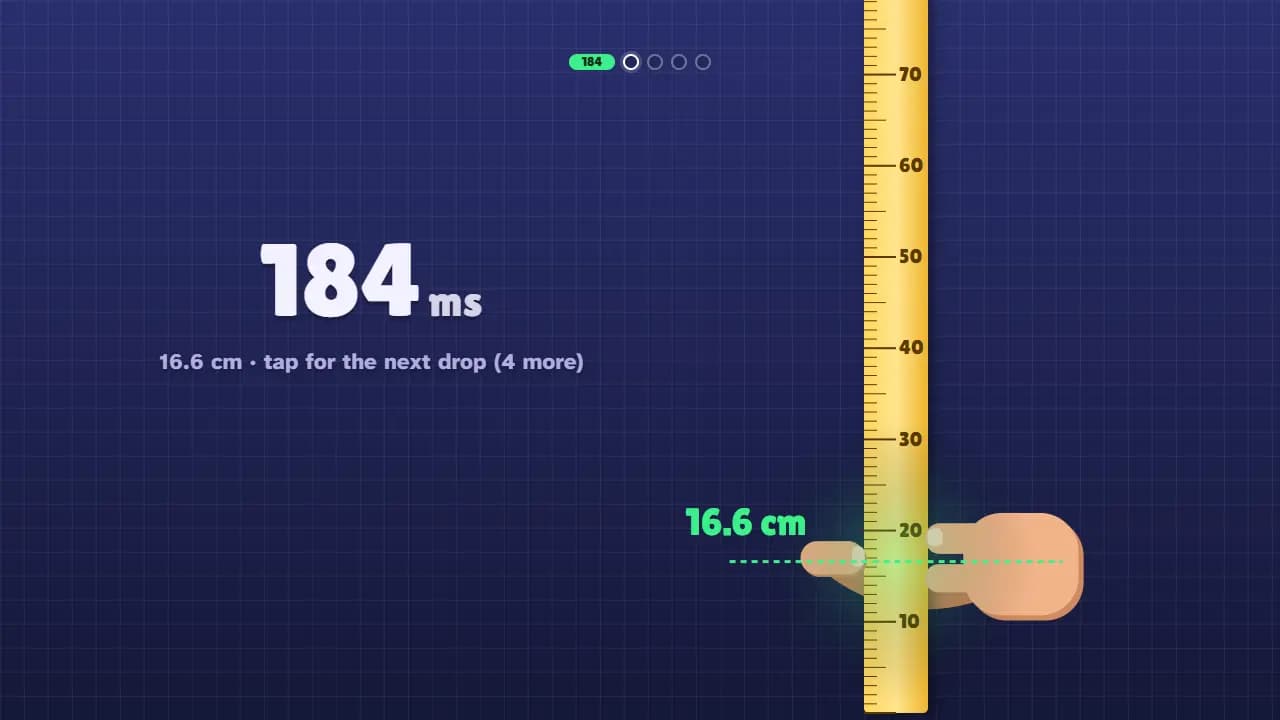
Ruler Drop: a metre stick caught between the fingers at 16.6 cm, which means 184 ms
How to take the reaction time test
- 1
Tap to start
Tap the big button, click or press any key. The screen turns dark red: wait.
- 2
Wait for green
After a random wait the whole screen turns green. Tap, click or press any key as fast as you can. Too early is a false start: just try that one again.
- 3
Five tries
Tap again for the next try. After five tries you get your average, your rank and how you compare.
- 4
Try the reflex games
Open the menu at the top left for the Western Duel, Goalkeeper, Start Lights, Sound Reaction, Aim Trainer, Ruler Drop and the Daily challenge.
Controls
| Input | What it does |
|---|---|
| Click or tap | React (and start the next try) |
| Any key (Space, Enter...) | React with the keyboard |
| ← → or A D | Dive left or right (Goalkeeper) |
| Esc | Stop a round, or open the menu |
| Enter | Try again (on the results) |
What you get
- Ready the moment the page opens: no Play button
- Classic reaction time test: 5 tries, average, fastest and slowest in milliseconds
- False starts and guesses are caught, with a fresh random wait every try
- Speed ranks from Koala to Housefly, and a comparison with adults in a published study
- Six reflex games: Western Duel, Goalkeeper, Start Lights, Sound Reaction, Aim Trainer and Ruler Drop
- A Daily challenge with the same waits for everyone, with a streak
- Challenge a friend with a link to your score
- Your progress chart and your bests in every game, saved in your browser
- Works with a mouse, a touchscreen or a keyboard, on computers, Chromebooks, tablets and phones
How to improve your reaction time
Get comfortable first
Rest your finger on the mouse button or just above the screen, so the only thing left to do is press. Every centimetre your finger travels costs time.
Watch, don't guess
The waits are random, so guessing gets you false starts. Relax and keep your eyes on the middle of the screen.
Use the keyboard or a wired mouse
Devices add delay before the game sees your press. A wired mouse or a key on a computer is often a little quicker than a touchscreen.
Be awake
Tiredness slows simple reactions more than almost anything else (Lim and Dinges, 2010). Your best scores will come when you're fresh.
Practise with games
In studies, people who play fast action video games respond faster without making more mistakes, and some training studies suggest the effect can be learned (Dye, Green and Bavelier, 2009). The reflex games here are a fun way to practise.
Compare like with like
Your phone, your laptop and your gaming PC will give different numbers. Track your progress on one device.
Frequently asked questions
What is a good reaction time?
On this test, on a normal screen, an average around 250 to 300 ms is typical, under 250 ms is quick and under 200 ms is very fast. In a lab study of 1,469 adults the average was 231 ms (Woods and others, 2015), but home screens, mice and browsers add some delay that lab equipment doesn't.
What is the average human reaction time?
For a simple reaction to a light, adults average about 230 ms in the lab (Woods and others, 2015). Reactions to a sound are often a little faster: classic textbook values are 180–200 ms for a light and 140–160 ms for a sound (BioNumbers).
How does the reaction time test work?
Tap to start. After a random wait the screen turns green; tap as fast as you can. The game measures the time between the green frame being shown and your tap, in milliseconds. You get five tries and your average. Tapping early is a false start and doesn't count.
Why is my reaction time different on my phone and my computer?
Every device adds a little delay: the screen takes time to show the green, and a touchscreen or wireless mouse takes time to report your tap. Studies of web browsers measured about 80 ms of delay on average (Anwyl-Irvine and others, 2021). Compare your scores on the same device.
Can you improve your reaction time?
You can get more consistent, mostly by being rested, focused and comfortable, and by not guessing. Studies also found that people who play fast action video games respond faster without losing accuracy (Dye and others, 2009). The reflex games here are a fun way to practise.
What is a choice reaction time?
A reaction where you have to pick, like diving left or right as a goalkeeper. It's slower than a simple reaction, and it gets slower the more options you have (Hick's law). Try the Goalkeeper game to test yours.
How do you do the ruler drop test?
A friend holds a ruler between your open thumb and finger and drops it without warning; you catch it. Read off how far it fell: 10 cm is about 0.14 s, 20 cm about 0.20 s and 30 cm about 0.25 s. Or play the Ruler Drop here, which does the maths for you.
What is an aim trainer?
An aim trainer is a reflex game where targets appear around the screen and you hit them as fast and as accurately as you can, to practise your mouse or touch aim. Ours has 20 targets and scores your average time per target and your accuracy.
Is this a medical test?
No. It's a game for fun and practice. It can't diagnose anything or tell you about your health.
Are my results saved?
Yes, your bests, history and daily streak are saved in your browser on this device. There's no account. Clearing your browser data resets them.

Comments